| Simon Bartolds Biomechanics Blog |
If we believed everything that was written, every athlete should now be running in a minimalist shoe, with minimalist gradient or “drop”, and that in doing so he or she would achieve perfect form, a more “natural running experience’, and far fewer injuries. We could also be led to believe that the more ‘traditional’ style of shoe, built off a higher midsole platform, is the root of all evil, compels the runner to heel strike, and is fundamentally responsible for the generation of injury in running.
I could probably put an end to this discussion right now by stating what the science tells us: that for some runners, a more minimalistic experience will be beneficial, whilst for others, the mainstream approach to running shoe design will offer a more favourable experience.
However, the passion of the debate, and the misuse, misinterpretation and misrepresentation of the science of athletic footwear design on both sides of the argument demands that we examine key issues more stringently and attempt to get better answers based on science.
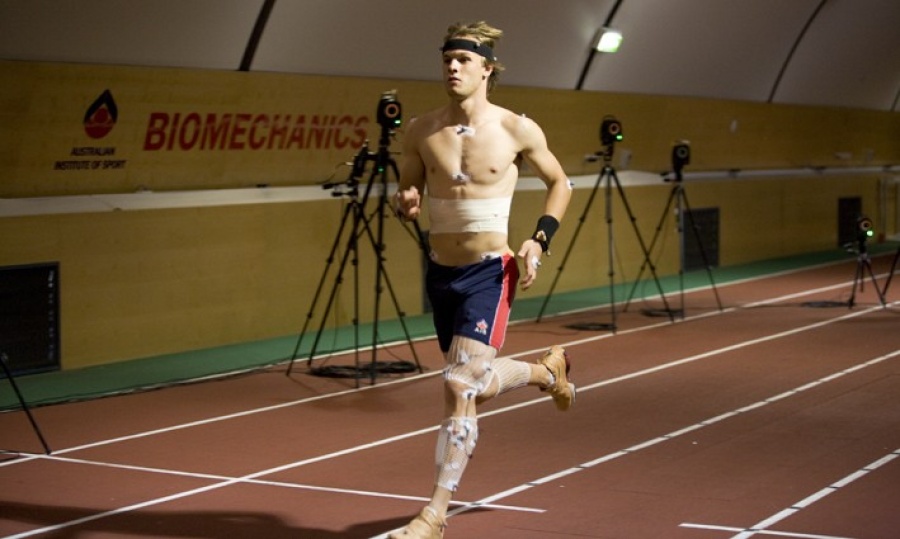
One of the most important discussions to be had is on the notion of “drop’, which is a relatively new term describing the differential of the height of the midsole, as measured from under the ball of the foot, to the heel. Traditionally this ‘drop” has been 10-12mm, whilst for minimalistic footwear it is anywhere from 0-4mm.
I am going to limit this discussion to this issue, and discuss the pros and cons of less or more ‘drop’.
First, let’s begin by defining terms.
If I was to be pedantic, I would say the term “drop’ is meaningless and a product of over simplification by the minimalist movement. A far better term would be heel height differential (HHD), but, for the sake of this argument, let’s use the term drop.
The “drop” is the height difference, measured in millimetres, of the midsole material underneath the heel, and underneath the ball of the foot. It is technically quite difficult to measure unless one is willing to separate the midsole from the outsole and upper, which naturally will render the shoe useless. An important point to note is the ethylvinylacetate, EVA, which is the material used to make the midsoles of almost all athletic footwear, has a 4-6% error in its material composition. This means that if one buys a brand new pair of shoes and sits them on a table, the drop on the left shoe will almost certainly be different to the drop on the right shoe! In addition, when shoes are built, the drop does not scale for shoe size, meaning that the actual drop on a size 13 shoe will be different to that for a size 7, controlling for manufacturer, model and sex.
OK, with that said, let’s take a look at drop in more detail.
Over the past year or so, the term has entered our vernacular and has been empowered with many benefits. Chief amongst these are the assumption that the lower the drop, the more an athlete is require to change their footstrike position from a rearfoot strike to a midfoot or forefoot strike. There is the presumption that for all athletes, a midfoot or forefoot strike pattern is superior to a rearfoot strike, especially from an injury prevention perspective. More on that a little later. Furthermore, many supporters of the minimalist argument propose that the ultimate drop is zero, because this most accurately reflects the barefoot condition, and barefoot is presumed to be the ultimate state in which to run.
Now let me just be quite clear here and say that from an injury prevention perspective, there is absolutely no research anywhere in the published literature to suggest that athletic footwear is able to prevent injury. Likewise, we can find zero evidence to support the conjecture that running in a zero drop, low drop or the barefoot state has any injury prevention advantage over the shod state. The research simply does not exist.
I like the following statement from Dr. Ross Tucker and his excellent blog at www.sportssceintists.com:
“There is as yet no conclusive evidence that either proves or disproves the benefits of shoes or barefoot running, or links the mechanical characteristics of barefoot running to a reduced risk of injury. That is, for all the work showing how impact forces and loading rates are reduced when barefoot, it remains to be proven that this leads to lower injury rates.”
He goes on to say:
“The evidence so far suggests that barefoot running produces some potentially beneficial changes, mostly related to how running form and kinetics are altered without shoes. However, it also points to a potentially large group of people who, when running barefoot, may have increased risk of injury, especially early on.”
So for the moment, the jury is out, and in time, the studies will come that clarify the situation.
Let me say that I believe there are good arguments, under certain circumstances, for runners to wear far less structure footwear, lighter and with a lower drop. For me, as a part of a balanced training program, particularly for the more accomplished runner, this makes sense, and I would personally recommend it. The same goes for barefoot running, which, on the right surface, and properly introduced into a balanced training program, can probably benefit most runners.
The key caveat here however, it that these comments do not apply to every runner, and there will be a substantial percentage of runners who will never be able to run barefoot, and never be able to run in a zero drop shoe.
OK, so let us now put the issue under the microscope and try to answer some of the key questions raised, and indeed statements made. Amongst these are:
A zero drop shoe whether it is 0 / 0 or 20 / 20 will make you run more …..
1. Efficiently
The assumption is likely to be along the lines of:
• “because barefoot or minimalist running reduces the weight over traditional footwear, there is a clear benefit in terms of energy expenditure”.
Hmmmm... well, maybe, but energy expenditure is commonly measured by monitoring oxygen uptake during running, and the above statement assumes that footwear will incur a greater oxygen uptake than barefoot running. This makes complete sense given the foot is at the end of the leg and acting somewhat like a pendulum. Increased weight of, or on, the foot increases energy expenditure right?
Well.. maybe not. A very recent study (Metabolic Cost of Running Barefoot versus Shod: Is Lighter Better? Jason R. Franz, Corbyn M. Wierzbinski, and Rodger Kram, Medicine & Science in Sports & Exercise, Publish Ahead of Print, February 12th 2012 ) brings this into focus. The key findings were as follows:
1. For every 100g [3.5oz] (the average weight of a deck of playing cards) added per foot, energy cost increases by approximately 1% whether running barefoot or shod.
2. Running barefoot and in lightweight shoes do not significantly differ in energy cost.
3. When controlling for shoe/foot mass, running in lightweight shoes requires ~3-4% less energy than running barefoot.
So, according to Alex Hutchinson, a scientist now writing for Runner’s World, there are 3 possible ways these results can be interpreted:
1. Running in shoes takes less energy than running barefoot.
2. The heavier your shoes are, the less efficiently you run.
3. Running barefoot "offers no metabolic advantage over running in lightweight,
cushioned shoes."
For the record, the official conclusion of the study was option 3.
This study looked specifically at barefoot vs a lightweight shoe designed for racing, and so we still do not have conclusive data for zero drop, either at 0/0mm or 20/20 mm. That said, it seems intuitive that based on the research, the issue in terms of efficiency (as measured by O2 uptake) is more one of the shoe’s weight than anything else. This being the case, the less midsole material the better, but this is not related to actual drop.
A zero drop height whether it is 0 / 0 or 20 / 20 will make you run ….. 2. Faster ?
There is no evidence whatsoever to support this notion, which is probably based on the (false) assumption that a zero drop shoe will enforce a midfoot or forefoot strike pattern, and that these gait characteristics encourage speed. In terms of speed, and remember this discussion is confined to distance running, not sprinting, running footwear takes a very secondary role to technique, strength and aerobic training. Running is like every other sport, it is a learned skill, and the more you practice the better you get. The barefoot and minimalist debate has unfortunately ignored the importance of running specific strength training, proper coaching of running technique (now masked in the term ‘form’), and correct recruitment of the muscles required to make one run faster.
The argument that a zero drop shoe, or for that matter a minimalist shoe of any description, will make a runner faster is akin to supposing an expensive set of golf clubs will make a novice golfer shed strokes like a pro. The clubs will make little difference until the player has perfected the swing and worked on strengthening and correctly recruiting the muscles required to hit the ball with precision and in a reproducible manner for 18 holes!
Having said this, as one becomes a more accomplished runner, and especially if the athlete is trained from an early age, the shoe becomes very important in terms of advantage gained. Sub-elite and elite runners most likely will have good style, will have had access to coaching, and will have developed the strength and aerobic capacity to be very good or great runners. The rules for these athletes are not the same as for the weekend warrior or novice. For these runners, any performance gain is important, and so training regimes, nutrition, footwear and a host of other factors become very important. Incorporating footwear, for example a racing flat (so called because they are designed to race in!), into the footwear quiver, will no doubt be of benefit, and may well make a difference to race times. Back to the golf analogy, with all sport, technique, strength and fitness always come before equipment in terms of performance. Assuming a shoe will make one run faster is taking a major shortcut that is very unlikely to pay dividends.
A zero drop height whether it is 0 / 0 or 20 / 20 will …..
3. Change your gait, to a more Forefoot / midfoot runner ?
This is perhaps the most common and oft quoted assumed benefit of zero drop footwear, and like many of the other assumptions, it simply is not true across the board.
I will again defer to an opinion other than my own and quote Ross Tucker (www.sportsscientists.com):
“It's also vital to recognize that huge differences may exist between individuals: some adapt very quickly to minimalist shoes or barefoot running - these people are the "responders" and they tend to go on to become "evangelists" who tell everyone to throw away their shoes! At the other extreme, however, are non-responders, who, for reasons unknown, will battle to run without "traditional shoes". In both cases, we have to be careful about generalizing the "extreme" observation to the general population. That's the mistake shoe companies made when telling everyone they needed all manner of gadgets in their shoe, and it's a mistake that people now make when advocating barefoot running.”
Sensible advice indeed, and underlining the danger of applying a “one size fits all” philosophy.
Let’s turn our attention to what the science says about this issue.
The assumption behind this statement is that midfoot/forefoot striking is superior because it reduces the impact transients of heel strike (thereby presumed to reduce injury), and that zero drop or minimalist footwear will automatically promote this strike pattern.
The science does not support this premise.
Mc Carthy and co workers (Like Barefoot? Only Better? Mc Carthy et al, 2011, American Council on Exercise Certified News September 2011) recruited 16 healthy, injury-free female subjects, ages 19 to 25, all of whom were considered recreational joggers. Two weeks prior to testing, each of the subjects was fitted with a pair of Vibram FiveFingers Bikila ($90). To get accustomed to running in the Bikilas, the subjects were then asked to wear the shoes while running for up to 20 minutes per day (or until discomfort), three times a week for two weeks. Once acclimated to running in the Vibrams, subjects returned to the lab for 3-D motion analysis and measurement of ground-reaction forces as they ran under three separate conditions: (1) while wearing the Vibrams; (2) while wearing a pair of
neutral running shoes (New Balance 625); and (3) while barefoot. The order was randomized between Vibrams and the running shoes, but the barefoot condition was always measured last.
The results? Mc Carthy and her team reported that all of the subjects were rear-foot strikers while wearing typical running shoes, landing predominantly on the heel. However, while
running barefoot and in Vibrams, approximately one-half of the subjects switched to a forefoot strike pattern while the other half continued to impact the ground with their heels. Most of the barefoot/ minimalist/ Born to Run crowd tell us this is impossible and that it would hurt too much, but in this controlled experiment, this is exactly what happened. So, only 1 in 2 of the runners in this study, after training three times a week (with someone literally standing next to them instructing them on how to run!) for two weeks in the Vibram shoe, were able to achieve a forefoot strike pattern. This study clearly does not support the supposition that zero drop or barefoot compels the runner to change their footstrike pattern.
“It’s tough to re-learn to run,” says Dr. John Porcari, one of the principle researchers. “When you look at the data even though we encouraged them to run with a more forefoot strike while wearing the Vibrams, half of the subjects still continued to land on their heels. Even with two weeks to practice and instruction in how to use the barefoot shoes, [the subjects’] bodies still tended to run the way they’ve always run.”
This makes complete sense, since that is the way the vast majority of us run, and heel striking probably allows us to conserve energy.
A zero drop height whether it is 0 / 0 or 20 / 20 will …..
4. Reduce injuries ?
There is no evidence anywhere to establish that wearing athletic footwear of any drop, 0 or otherwise, will reduce the incidence of injuries. Likewise there is no evidence whatsoever to indicate that running barefoot will reduce injury. Although it is often quoted that running in zero or reduced drop footwear will reduce injury, the practical explanation for any observed effect may well be that it is just not possible to train hard enough to injury oneself when running barefoot or in a minimalist shoe!
What we do know is this: Minimalist footwear with a reduced or zero drop clearly encourages a more anterior foot strike pattern to traditional footwear (midfoot or footfoot if you like). A more anterior initial foot contact present in barefoot or other alternative running styles may decrease or eliminate the initial vertical ground reaction peak or "impact transient," possibly reducing knee joint loads and injuries. A more anterior foot strike, however, may increase mechanical work at the ankle and tensile stress within the plantarflexors. Wearing minimal footwear may also increase contact pressure imposed on the metatarsals. (Goss et al 2012)
The interpretation of this statement is the fundamental law of physics, “energy cannot be created or destroyed, only shifted”! If load is decreased at the level of the knee, as with barefoot or reduced drop footwear, it has to go somewhere. So in this instance, a small reduction in knee joint loading with low drop footwear results in a large increase in ankle joint moments and strain on the structures of the arch of the foot, particularly the plantar fascia.
One of the key arguments for a change to zero or reduced drop footwear is that actual injury patterns have not changed in the past 30 years. The Assumption then is that traditional shoes clearly do not work.
The argument here is that injury rates were 70% in the 70s and 70% in the 2000s. So, despite shoe technology, which is hugely different, we still get injured just as much. And sure, this is true, but we are not comparing apples with apples. For example, in the 70’s, Nintendo did not exist, or any other computer game for that matter, so the degree of cultural deconditioning was far less (as was the level of obesity). In the 70’s, if you ran, you were a serious runner. Today we have people who spend the majority of their waking hours sitting at a desk, overweight, poorly conditioned, planning to run a marathon. So, the data is skewed.
When I think of running in the 70s, I think of Frank Shorter, Bill Rodgers and a little before them Pheidippides - small, wiry, probably ultra-economical. In Pheidippides case, Greek.
When I think of running in 2011, I think of Oprah Winfrey... sorry Oprah. Simply, the people who run marathons today are not the same kind of runner. They are heavier, slower, and probably do less training but then still run the marathon distance. When viewed this way, it's perhaps not surprising that 70% are getting injured. If anything, it suggests that shoes may be helping, because many of the runners of 2011 are walking/jogging/running injury risks!
A zero drop height whether it is 0 / 0 or 20 / 20 will …..
5. be better than 10mm ?
The chief arguments in support of this statement seems to be that;
1. a zero drop shoe will compel the runner to change their gait pattern to a midfoot or forefoot strike, and that this will somehow be superior.
Whilst many elite distance runners do indeed have a midfoot or forefoot strike pattern, history is littered with champion distance runners who just as happily rearfoot strike. Think Abebe Bikila and in the modern era Meb Keflezighi and Haile Gabrselassie (who’s distance incidentally was 10,000m, a distance over which we may expect a more anterior heel strike).
The thought processes are that a heel strike causes an initial heel impact transient (called Fz1 as measure by vertical ground reaction force data), and that this initial heel impact may be related to injury. The fact is that this is unproven. Furthermore, zero drop proponents argue that it is impossible to heel strike in such footwear (already disproven, see above), and therefore there will be ‘no impact’, and so no problem.
Well, there is an impact, it is called Fz2 or the “active impact” and it is larger than Fz1. If we apply a Fourier transformation algorithm to Fz2, we see the frequency domain of this peak is way higher than for Fz1, and high input frequencies are linked to injury in runners! In addition, landing on the forefoot requires a large eccentric loading of the triceps surae (calf muscles), Achilles tendon and intrinsic structures on the sole of the foot. This is the reason runners transitioning to zero drop footwear frequently have problems in these areas.
2. A traditional shoe will cause the runner to be a heel striker.
I have several problems with this statement, not the least of which is that this somehow assumes there is some issue with heel striking. There is not. In fact, two recent studies have looked at this exact issue.
The first, Foot strike patterns of runners at the 15-km point during an elite-level half marathon. Hiroshi Hasegawa; Takeshi Yamauchi; William J Kraemer
Journal of Strength and Conditioning Research; Aug 2007; 21, 3, found that 74.9% of all runners in the cohort (283 runners), were heel strikers.
The second study, by Pete Larson and co-workers, whom many of you will know as the administrator of Runblogger, found even more support for heel striking amongst marathon runners. Larson, P, et al, (2011): Foot strike patterns of recreational and sub-elite runners in a long-distance road race, Journal of Sports Sciences, 29:15, 1665-1673 found that of 936 distance runners studied, 88.9% of runners at the 10km mark were classified as rear foot strikers, 3.4% as mid foot strikers, and only 1.8% were fore foot strikers!
This study also found that “A large percentage of runners switched from midfoot and forefoot footstrikes at 10 km to rearfoot strikes at 32 km”, and the authors surmised that this was “presumably due to fatigue”.
So this begs the question, if midfoot or forefoot striking increases fatigue, why would we consider it superior to heel striking, the ambulatory style overwhelmingly favoured by most runners, including many elites?
So let’s be clear here, a zero drop shoe will not make one run faster, nor will it reduce injury. The same can be said for traditional running shoes. A shoe with less midsole, a racing flat for example, will be lighter and will encourage kinematic changes that may help a developing or accomplished/expert runner race better. Hence the term “racing flat”.
So given 80% of all runners will be heel strikers, what does that say about shoe requirements?
There are a myriad of studies showing that athletic footwear
• Alters acceleration
• Reduces pressure
• Attenuates dangerous frequencies
• Protects from the environment
• Reduces torques and moments
• Influences injury patterns
Let’s take a look at what the literature tells us
• Cushioning systems greatly increased comfort, reduced the occurrence of painful feet and allowed many people who would not otherwise have participated to enjoy the “jogging boom”.
• Cushioning in athletic shoes has been shown to attenuate skeletal shock transients and to reduce peak plantar pressures (from Shorten M, Running shoe design: protection and performance 2005, included in references)
• Barefoot running is characterized by a significantly larger loading rate than in shod running and, in general, more than one impact peak was found for the barefoot condition. Yes, that is correct.. barefoot running increases the impact load (of course), and according to some this is what causes injury. (Biomechanical analysis of the stance phase during barefoot and shod running. De Wit ,B., De Clercq, D, Aerts, P. Journal of Biomechanics 33 (2000) 269}278 "
A zero drop height whether it is 0 / 0 or 20 / 20 will …..
6. Give you a different “running experience “ ?
Of course it will, but the question should be will it give one a better running experience? The answer to that one is, “it depends on the runner”. Going from traditional to zero drop shoes is a skill and involves a significant change. Therefore, it's essential to respect the time that it will take to fully adapt to the different loading stresses associated with running in a zero drop shoe. Ross Tucker for The Sports Scientists has estimated that it would take 12 weeks to build up to 40 minutes of solid running (plus 2 to 4 weeks of preparation). Some people may take even longer than this - For many keen to try the zero drop experience, the risk is substantial, and even excluding that, it will mean a very significant reduction to a training program, most likely back to scratch.
The question that has to be asked then is whether it's worth it? Is a 6-month intervention worth the benefit, when the benefit hasn't yet been clearly established? I, like Ross Tucker, doubt it.
I shall leave you with this final thought:
The issue is not necessarily whether minimalist running is "good for you", but rather whether minimalist running helps us understand anything about how we run that might help us reduce injury risk. If minimalist running provides these answers for a given runner, then of course it would be enormously beneficial. But it may be that simply learning about minimalist running helps runners in traditional shoes just as much!
References
Hasegawa, H., Yamauchi, T,. Kraemer, W.J., 2007, Foot strike patterns of runners at the 15-km point during an elite-level half marathon Journal of Strength and Conditioning Research; 21, 3; Journal of Strength and Conditioning Research; 21, 3
Larson, P, et al, (2011): Foot strike patterns of recreational and sub-elite runners in a long-distance road race, Journal of Sports Sciences, 29:15, 1665-1673
Like Barefoot? Only Better? Mc Carthy et al, 2011, American Council on Exercise Certified News.
Shorten M, 2005, Running shoe design: protection and performance
De Wit ,B., De Clercq, D, Aerts, P. 2000, Biomechanical analysis of the stance phase during barefoot and shod running. Journal of Biomechanics 33 269:278
Franz, R., Corbyn M., Wierzbinski,J., and Kram, R., 2012, Metabolic Cost of Running Barefoot versus Shod: Is Lighter Better? Medicine & Science in Sports & Exercise
Goss DL, Gross MT. A review of mechanics and injury trends among various running styles. US Army Med Dep J. 2012 Jul-Sep:62-71
|

 The concept of “drop”: what does it mean for the runner?